Silicon Valley Housing Market Update: What Buyers and Sellers Should Know in 2026

Author: Finance & Marketing Intern Matteo Gemmel
Linkedin Profile:
https://www.linkedin.com/in/matteo-gemmel-ch%C3%A1varri-301aa63b6/
Silicon Valley housing market snapshot using the latest available May-June 2026 data.
The Silicon Valley housing market in 2026
is giving buyers and sellers a more complicated picture than the headline numbers alone suggest. Prices have softened in parts of San Jose and Santa Clara County, inventory has increased, and borrowing costs remain elevated. At the same time, desirable homes that are priced correctly can still sell quickly and receive offers above the asking price. This article explains the latest market indicators and what they may mean for people planning a move during the remainder of the year.
A Market That Is Cooling, Not Collapsing
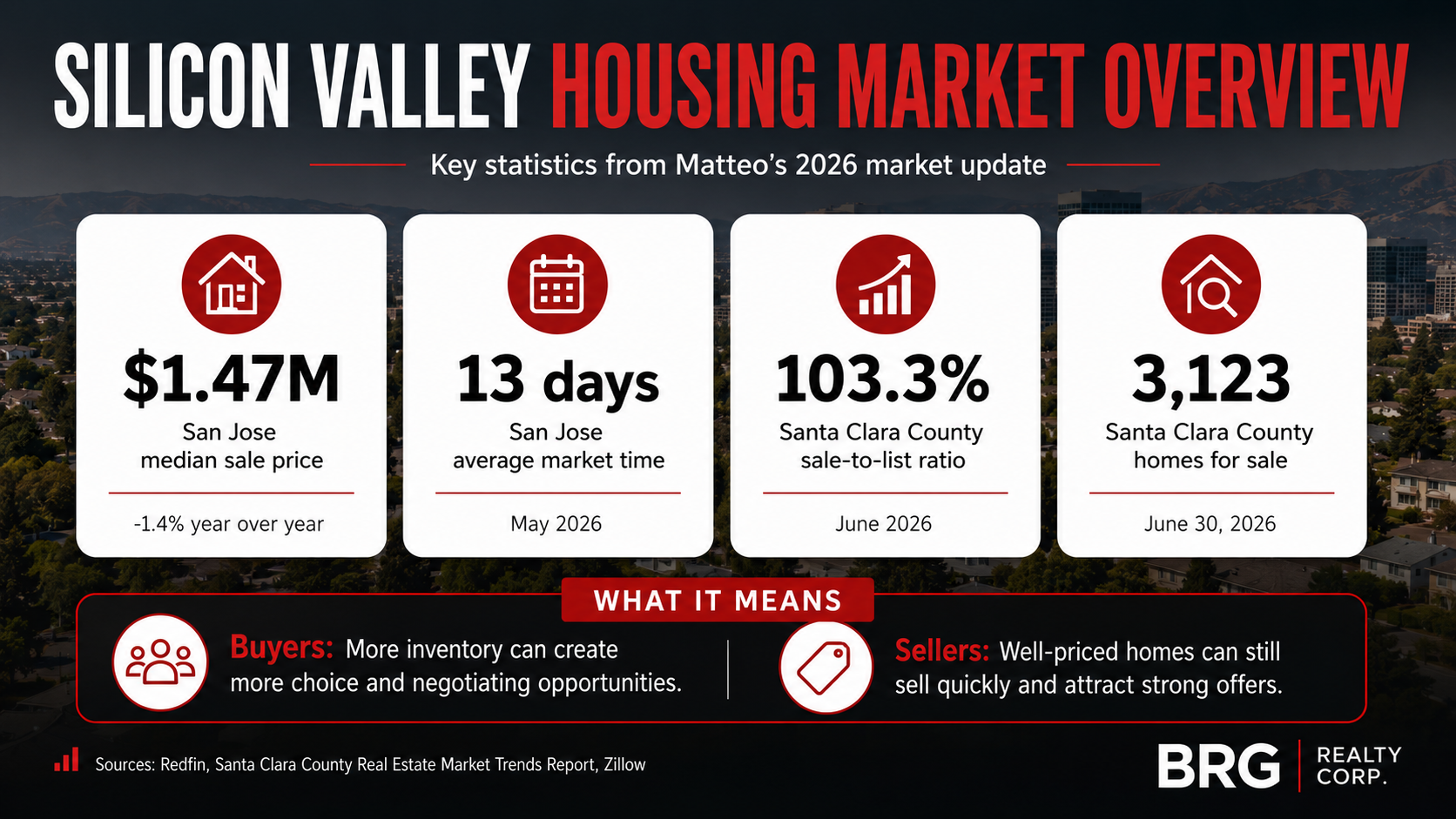
Recent data points to moderation rather than a broad market decline. Redfin reported that, over the three months ending in May 2026, the median San Jose sale price was approximately $1.47 million, down 1.4% from the same period a year earlier. Homes sold after an average of 13 days, compared with 12 days the year before, while May sales volume increased to 1,632 homes from 1,529.
Santa Clara County data shows a similar change in momentum. The Santa Clara County Real Estate Market Trends Report stated that the June median price for single-family resale homes declined 9.3% year over year, while the average sale price was approximately $2.51 million. The difference between median and average prices is a reminder that the mix of homes sold can significantly affect monthly statistics in an expensive and diverse market.
For buyers, softer prices and slightly longer market times can create opportunities. For sellers, the data does not mean that demand has disappeared. It means buyers are more selective and less willing to overlook an unrealistic price or poor presentation.
Inventory Has Improved, but Competition Remains
Zillow reported 3,123 homes for sale across Santa Clara County as of June 30, 2026, with 1,299 new listings added during the month. The county’s median time to pending was 16 days. More choices can reduce the pressure buyers felt during periods of extremely limited inventory, especially when several comparable homes are available in the same neighborhood or price range.
However, increased inventory does not automatically make Silicon Valley a buyer’s market. Zillow’s May data showed that 66.6% of county sales closed above the list price, while the median sale-to-list ratio was 102.6%. The Santa Clara County Real Estate Market Trends Report measured the June single-family sale-to-list ratio at 103.3%. In other words, the typical home was still selling above its asking price, even as overall pricing cooled.
The most accurate description is a segmented market. Updated homes in strong school districts, near major employment centers, or in areas with limited comparable inventory can still attract intense competition. Properties needing significant work, carrying an aggressive asking price, or located on less desirable streets may sit longer and require concessions.
Mortgage Rates Continue to Shape Affordability
Financing costs remain one of the biggest constraints for buyers. Freddie Mac reported that the average 30-year fixed mortgage rate reached 6.66% on July 30, 2026, compared with 6.58% one week earlier. At Silicon Valley price levels, even a modest rate change can materially affect a buyer’s monthly payment and purchasing power.
Higher rates can also influence sellers. Many existing homeowners have mortgages with lower rates and may hesitate to sell unless a move is necessary. This “rate lock-in” effect can limit the supply of certain homes and help support prices despite affordability challenges. Buyers should obtain a fully underwritten preapproval when possible and evaluate the complete monthly housing cost, including taxes, insurance, homeowners association fees and potential repairs.
What Buyers Should Do in the 2026 Market
Buyers have more room to be thoughtful than they did during the most competitive periods, but preparation is still essential.
A strong strategy should include:
- Reviewing recent comparable sales rather than relying only on the list price.
- Comparing how long competing properties have been available and whether they have received price reductions.
- Requesting inspections, credits or repairs when market conditions and the property’s condition justify them.
- Maintaining flexibility on location, property type or cosmetic condition to expand the available choices.
- Avoiding the assumption that every home will sell below asking, because the most desirable listings may still receive multiple offers.
A local real estate professional can help distinguish between a listing that is intentionally priced low to generate competition and one that may genuinely offer negotiating room. Buyers should also avoid trying to time the exact bottom of the market. A property that fits the buyer’s long-term plans, budget and lifestyle can still be a sound decision even if short-term market statistics fluctuate.
What Sellers Should Do Before Listing
Sellers can no longer assume that any property will attract immediate offers simply because it is located in Silicon Valley. Pricing and presentation are especially important when buyers have more alternatives. Before listing, sellers should review recent neighborhood sales, active competition and failed or withdrawn listings with their agent.
Small improvements can make a meaningful difference. Fresh paint, professional cleaning, landscaping, minor repairs, decluttering and high-quality photography can help a home compete. Sellers should also complete disclosures carefully and prepare for buyers to scrutinize insurance availability, roof condition, electrical systems and other potential ownership costs.
The initial asking price should support the seller’s goals without pushing the home outside the range buyers consider reasonable. Overpricing can cause a listing to lose momentum during its first weeks on the market. A well-supported price can create urgency, increase showing activity and produce stronger terms—even when the broader market is less aggressive than it was a year earlier.
Outlook for the Remainder of 2026
The most likely outlook for the remainder of 2026 is continued variation by neighborhood, price point and property condition. California’s statewide market remains active: the California Association of Realtors reported that June existing single-family home sales increased 6.0% from June 2025, while the statewide median price rose 0.4% year over year to $904,640. Silicon Valley may continue to experience softer year-over-year comparisons while retaining strong competition for its best-positioned homes.
Mortgage rates, technology-sector employment, stock-market performance and the pace of new inventory will all influence local activity. A meaningful drop in mortgage rates could bring more buyers into the market, but it could also increase competition. Conversely, rates that remain elevated may keep affordability constrained and give buyers more negotiating leverage on listings that do not immediately attract attention.
For both buyers and sellers, the key is to rely on current neighborhood-level information rather than broad national headlines. The Silicon Valley market can change significantly from one city, school district or price tier to another.
The Bottom Line
The Silicon Valley housing market in 2026 is more balanced than it was during the most intense seller’s markets, but it is not uniformly favorable to buyers. Prices have moderated, inventory has improved and buyers may have more negotiating opportunities. Still, short market times and above-list sales show that demand remains strong for homes that are properly priced and prepared.
Buyers should enter the market with a clear budget, strong financing and property-specific research. Sellers should focus on realistic pricing, presentation and a marketing plan tailored to current local conditions. In a market this segmented, experienced guidance and accurate data can make a meaningful difference.
Are you planning to buy, sell, or invest in Silicon Valley real estate?
Contact BRG Realty Corp to connect with an experienced local real estate professional.
Website: brgrealtycorp.com
Office: 408-558-3636
Address: 1900 Camden Avenue, San Jose, CA 95124
Sources
- Redfin — San Jose Housing Market Trends (May 2026 data)
- Santa Clara County Real Estate Market Trends Report — June 2026
- Zillow — Santa Clara County Housing Market Overview
- California Association of Realtors — June 2026 Home Sales and Price Report
- Freddie Mac — Primary Mortgage Market Survey, July 30, 2026